
📝 Agency Owner Blog
You Don't Have a Hiring Problem. You Have a Capacity Data Problem
I built DOT, the agency dedicated to running account management for other agencies. E2M acquired us in 2026. Every agency owner I worked with eventually asked me some version of the same question: is it time to hire, or am I just bad at managing my week?
Most of them were asking the wrong question. They were trying to answer a data question using a feeling.
"Everyone Feels Slammed" Isn't Capacity Data
Here's how the hiring decision usually gets made. The team feels stretched. Deadlines are getting tighter. Someone's staying late. So the agency owner assumes the answer is obvious: hire.
Sometimes that's right. Often, it isn't. Feeling busy and being at capacity are two different things, and most agencies only have access to the first one. Feeling busy can mean you're actually out of hours. It can also mean three accounts are overservicing, one person is absorbing all the unscoped requests, and you have a workload distribution problem rather than a capacity problem.

You can't tell the difference without real hours worked, logged accurately, by client and by person. Most agencies don't have that. They have timesheets filled out from memory on a Friday, which means the data driving a decision that costs $60,000 to $100,000 a year is, at best, a rough guess.
The Expensive Version of Getting This Wrong
Hiring off a feeling instead of data tends to go one of two ways, and both are costly.
You hire too early, for a capacity problem that was actually a workload distribution problem, and now you're carrying a salary you didn't need to carry. Or you wait too long because nobody trusted the "we're slammed" feeling enough to act on it, and your best people burn out or leave before you make the call.
Either way, you're making a six figure decision on vibes. I've sat inside enough agencies to know that's more common than anyone wants to admit.
What Real Capacity Data Actually Shows You
When your time data is accurate, the hiring question stops being a guess. You can see, by person, whether someone is actually at 100% of a sustainable workload or whether they're at 100% of an inflated one, full of out-of-scope client requests that were never priced in.
You can see whether the strain is agency-wide, which points to a real hiring need, or concentrated on two accounts, which points to a scoping or reassignment problem you can solve without adding headcount.
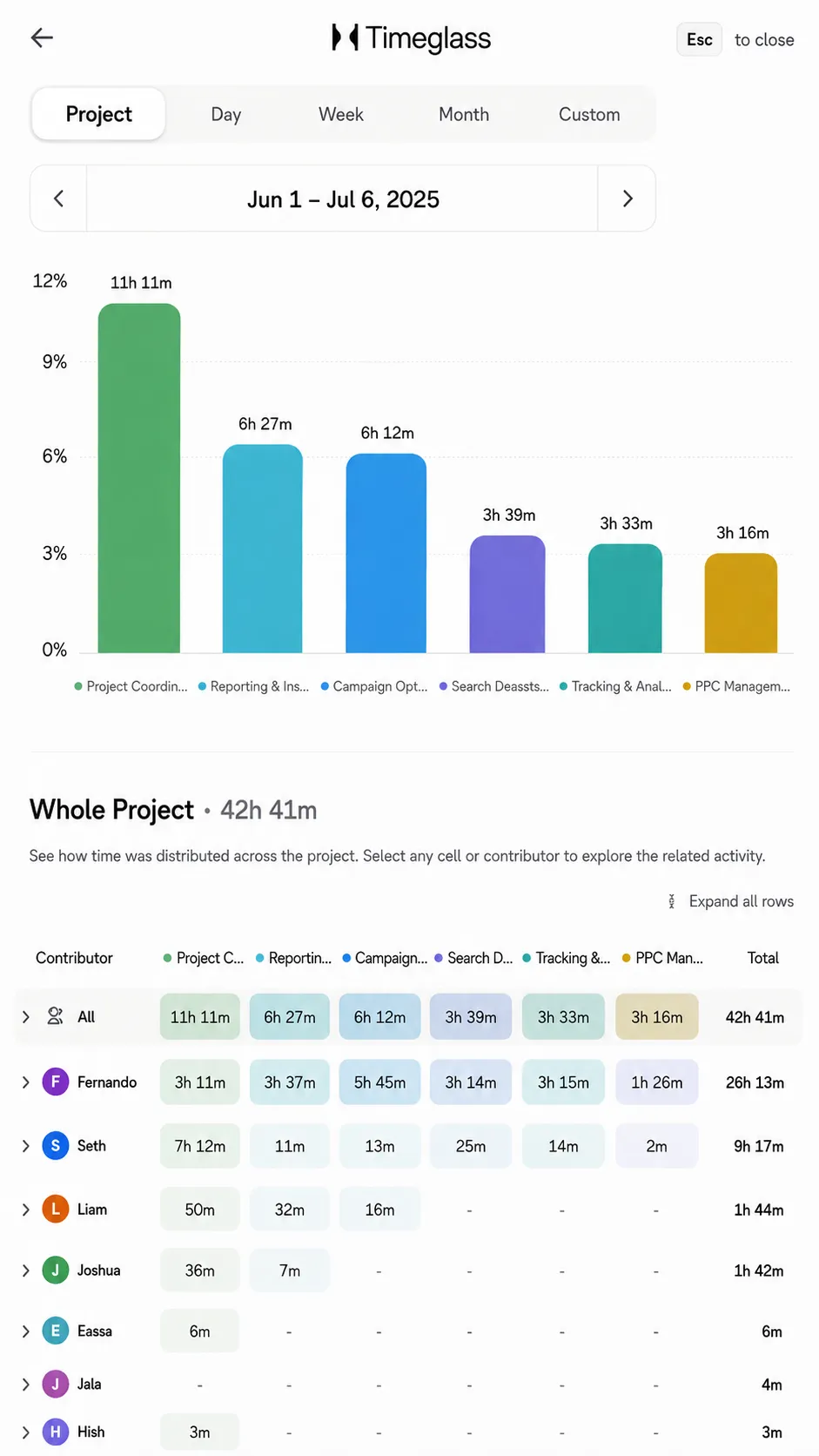
You can also see it early enough to plan the hire properly, instead of scrambling to onboard someone under pressure because the team hit a wall before anyone noticed it coming.
Why Manual Time Tracking Can't Give You This
The root issue isn't that agency owners don't care about capacity data. It's that manual timesheets can't produce it reliably. Asking your team to log time accurately, every day, in real time, is asking them to be their own surveillance system. Most people are bad at that, including your most conscientious account managers. Nagging them to just ‘do it better’ doesn’t work - it’s legacy timesheets themselves that are broken.
This is where Timeglass changed the equation for me. It writes your team's timesheets automatically, in the background, as the work actually happens, already matched to the right client and project. Your team's job shrinks to a quick review and approval instead of reconstructing a week from memory. What comes out the other end is hours worked, not hours guessed.
That's the data a real hiring decision needs. Not a vibe. Not a Slack message that says "we're drowning." Actual numbers you can trust.
The Question I'd Ask First
Before your next hiring decision, before the offer letter or the job post, I'd ask this: do you actually know, by person and by account, where your team's hours are going right now? If the answer is no, that's worth fixing before you spend six figures on a guess.
Timeglass is offering 50% off for the first 3 months, using code HAPPYCLIENTS.
Check them out at timeglass.ai.

Timeglass is offering 50% off for the first 3 months. Use the code HAPPYCLIENTS to get this.
Get the capacity data right first. The hiring decision gets a lot easier once you're not guessing.
◀ Previous Blog Post

The Illusion of Owning an Employee
Next Blog Post ▶

Delegation Didn't Fail. You Skipped the Middle
AGENCY OWNER RESOURCES
GROW YOUR AGENCY
THOUGHT LEADERSHIP
LEGAL
WORK AT DOT
THOUGHT LEADERSHIP
Testimonials
Agency Owner Blog
Happy Clients Podcast
FAQs
WORK AT DOT
Careers
LEGAL
T&C
Privacy Policy



© 2026 Dot & Company, an E2M company.
All rights reserved.